Showing posts with label temple. Show all posts

Monday, January 4, 2021

The gardens of Tofukuji temple

 The important building in Tofukuji temple has 4 gardens designed by a modern garden designer, Shigemori Mirei.  

Shigemori Mirei was not originally a garden designer. He studied Japanese art, tea ceremony and flower arrangement in his early time. Then he went all over japan to conduct on-site research of all the traditional Japanese gardens and compiled the books of Japanese gardens. While doing this, he realized that Japanese gardens were an art. They abstract the nature and express it three-dimensionally. In a sense, it is something like a sculpture. Keeping classic art as a foundation. he aimed at eternal modernism

Let's see the gardens.

The South garden.
This set of stones represents the ancient Chinese belief. What is special here is the way of placing stones. Mirei laid 6 meter-long stone here. He created the wonderful stone-set keeping the best balance with standing stones. 


The moss shows 5 great mountains in Kyoto. The line between the moss and pebbles goes gently, which shows the different atmosphere of the stone set. 


The West garden shows a traditional Japanese pattern called Ichimatsu with white sand and azaleas. The moss continues from the south garden to this garden.


The north garden.

It has a smaller Ichimatsu pattern. When you see this garden, you will find that the left side has a clear and neat pattern but as it goes to the right, the pattern becomes blur and disappears at the end. This is affected by the technique of Japanese old paintings, which makes variety by making the border blur.


These stones represent the seven stars in the sky. It is unlikely that  the factor of constellation is used for the garden. In addition, these stones were used as cornerstones of the old lavatory.

Why Mirei used the old materials? It is because of zen teaching. When he designed the gardens, he was told to use the old materials to eliminate waste.


I can say that you will enjoy a little different but traditional zen garden here.


Saturday, January 2, 2021

Tofukuji temple

 This temple has a long history dating back to 1236. One of the court nobles, Kujo Michiie, founded this. Tofukuji was named after the great temples in Nara, Todaiji and Kofukuji. It uses a part of the names. 
Todaiji in Nara has a large Buddha statue, and Tofukuji also had a large Buddha statue in the past. Unfortunately, because of the fire, we can no longer see it .

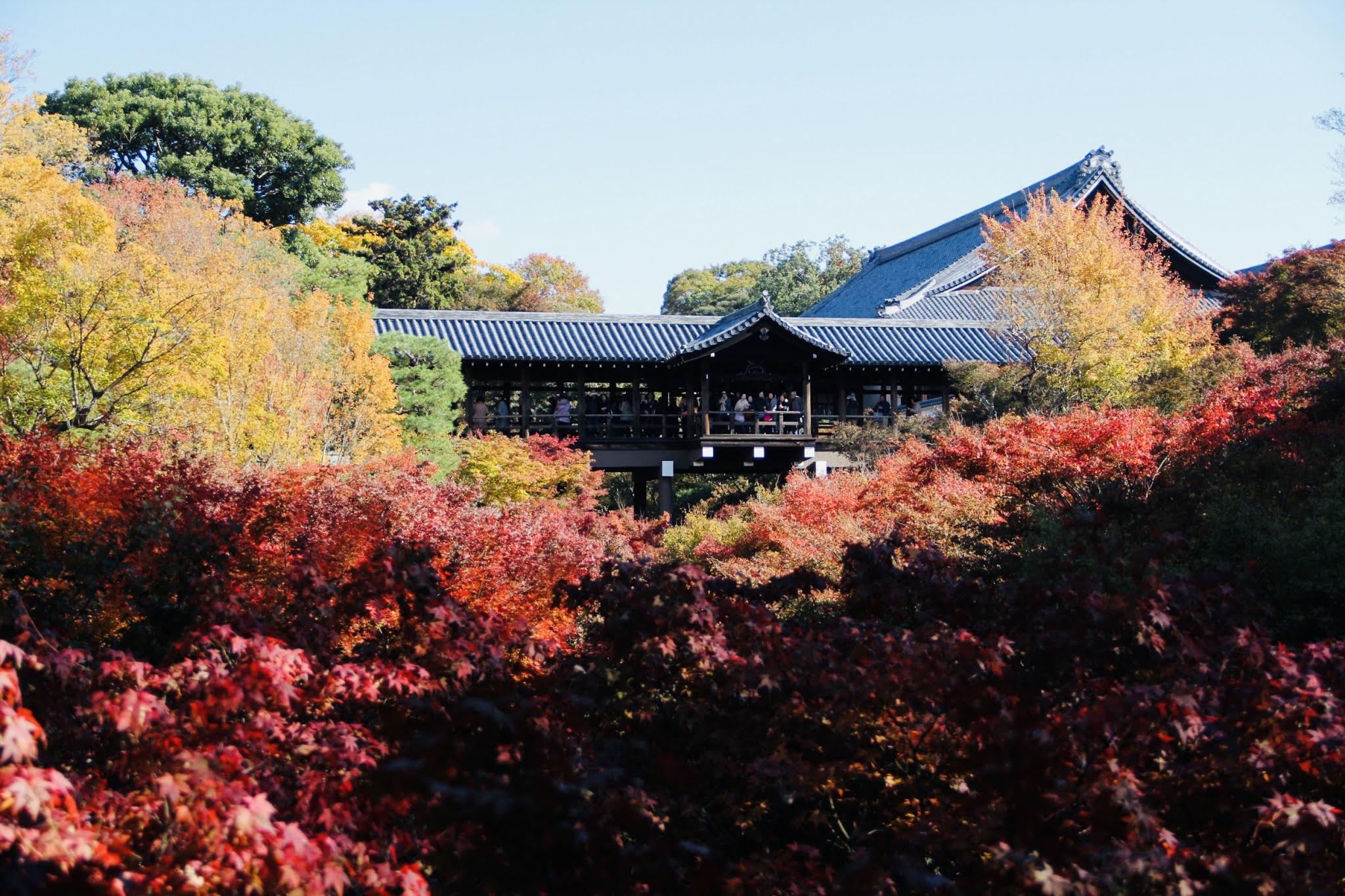
The large precinct has many buildings such as an old lavatory, Sanmon gate, Hatto hall, and hojo builging. But most famous here is a valley covered with maple trees.

In the 15th century, the temple has a monk who was very good at painting. Due to his fine works, the shogun asked his what he wanted. He requested  to remove all the cherry trees in the temple because it is a nuisance in zen training. For that reason, this temple doesn't have any cherry trees but maples.
Now they attract many tourists from japan and overseas.

The monk who studied Buddhism in China brought tea seeds back to Japan, and planted his home town in Shizuoka. Today, we can enjoy very nice tea from Shizuoka thanks to him. He was the first monk of this temple.
( The monk who brought tea seeds to Japan first in our history is Yosai, a different monk, Yosai brought the seeds and planted in the North of Kyoto )

Sanmon gate which has three entrances is the typical gate seen in zen temple. Each of the entrances is said to show three ways to attain enlightenment. the gate of emptiness, the gate of no thought ( prejudice), the gate of no desire. 
What is interesting is that the pillars have square halls. I heard they are  for taking a balance of all the pillars. 

The zen hall is the oldest in Japan. It still has many monks for training occasionally. 

The old lavatory is large so that about 100 monks could use it at a time  in those days. 
The sanitary system here was amazing. Because many monks were accommodated  and had their lives together, bad diseases must not occur. 

In Hatto hall, you can see dragon painting on the ceiling. It is painted by a modern artist, Domoto Insho.  When he painted, he needed a large amount of Chinese ink. For him, many monks made a line putting a suzuri ink container and rubbed a ink bar to make ink for him.

Please enjoy the movie of Tofukuji temple


Monday, July 15, 2013

A quiet place- one of my favorites


The most of Japanese gardens are miniatures of the national landscape. Rocks symbolize a mountain or land, and ponds and sand represent the ocean or the sea.

But the world of Koetsu-ji temple is life-sized garden because this is a garden related to tea ceremony. Here is said to have been a residence of Honami Koetsu, who was born in the family of sword appraiser To be a sword appraiser, he had to have a wide range of knowledge in art and craft. After he was ordered to live there, the place changed to be something like an art village because many artisans moved there after Koetsu.

Koetsu was a very talented man in various fields, especially tea ceremony, In this temple, seven tea houses were built in Taisho era thanks to the donations by so-called zaibatsu (in Japanese )
Please enjoy the world of tea

More than anything, this quietness  and greenery makes a specific atmosphere here.
Just sitting here and viewing three mountains of Takagamine from here will be the best way of enjoying this temple.


Koetsu ji temple

Friday, May 24, 2013

GizoBosastsu ( a Buddhist saint )

Among Botasu, probably Gizo-Bosatsu (bodhisattva ) is most loved by the people, called Gizo-san.


It is said that Gizo Bosatsu can go any of  6 worlds in Buddhism and salvage suffering people from there.

There used to be a man called Onono- Takamori, who could go to and come from  another world. One day, when he was in another world, he saw a man who was walking in the hell with the edge of his clothes burning. The man was trying to salvage the suffering people there in spite of the burning clothes. That was Gizo.


I heard another story.

When babies or young children died and went to the border of another world, they miss their parents and cry and cry.
At that time, Gizo comes and take them, by holding their hands, to the heaven. 
When you walk along Teramachi street from Sanjo to Oike street, you will find a small temple called "Yata dera" temple.

 Can you see a bell in front of you? In Kyoto, there are two bells. One is the one for welcoming the departed soul to come home during Obon period in Buddhism
It is in Rokudo-chinko-ji temple..
 The people go to what is called "Rokudo-san" to ring the bell to tell their family in the heaven that they are ready to welcome them in Obon.
( Obon period is mid of August )

The other one is here. That is for sending the soul to the heaven. 


This is a charm with a shape of Gizo- san. How cute! People write their wish on its back. Some people go back home with it, and others leave it in this temple.
Somehow, when I was here, I felt my heart eased. 
This temple is very small but I am sure you will like it.

Why don't you come to see this cute Gizo-san?


Thursday, May 23, 2013

Quiet place - one of my favorites


Even the temple near here is so crowded, this place still keeps quietness. 
That is why I like this temple. The entrance road to the gate is really easing.
I can't show you how the place is impressive with the picture. 

Ho-nen-in temple. When you are walking along Philosopher's path from Ginkakuji temple, you will find a small wooden sign which says "Honen-in" A few minute walk from here brings you to this quiet place.

The great monk, Ho-nen, who started Jodo-shu sect used to chant a prayer to the Budda, He was always chanting a prayer here. saying " Namiamu dabutsu"which is said to take you to the paradise in the heaven after your death.
When you walk in through the rusty gate, you will see two mound of sand. This expresses water.
Just walking between the two, you will be purified by the water.

 Except the special occasion, we can't enter the inside of the hall. But just walking around in the precinct is enough to satisfy and ease you.
Why don't you drop in at this temple on the way from Ginkakuji temple to Nanzenji temple?

Time 6AM to 4PM


Wednesday, May 1, 2013

Byodoin temple


In some Japanese gardens, we can find something to be delicately devised. Let's think about the garden in Byodoin temple. As I talked before, the people in those days were eager to realize the pure land in Paradise here in Uji. That is why you can see phoenix hall in the west. When you see the hall from across the pond, the face of Amida Buddha can be seen just through the round window of the hall. When you stand in the hall, look up the corner of the ceiling. The wavy light there is something like the one in the heaven. Yes. But how does it waver like that ?
Look at the left corner of the pond! It is just behind the edge of the hall. Did you notice that there is a little fountain at this point of the pond? Water springs little by little, which ruffles the water surface. The water surface reflects the sun light and it gives an irregular pattern of shimmering light to the ceiling and the wall. In the old days, they felt as if they were in pure land in Paradise when they saw it.
To tell the truth, when I stood in the hall, the hall itself was actually very old and I couldn't feel I was in pure land. But the time when it was built, the color of the building was so vivid and colorful that it was totally different from what it is today.

Amida Buddha is said to come with an orchestra so that the dead won't have a fear at the moment of the death and take them to the heaven. The Amida Buddha is right in the center of the hall.
Thinking of the people and the hall in the old days, it makes me a little romantic.

Now Byodoin temple is under repair. The repair is scheduled to be completed in March, 2014

Mourning the dead ( Adashino Nenbutsu dera temple )


People in the old days believed the paradise in Pureland was located in the west. We can find the fact in Byodoin temple in Uji because you will see the phoenix hall to the west when you see it across from the front pond. The west is the direction where the sun sets.
Adashino Nenbutsu dera( temple) is in the west of Kyoto, the end of Arashiyama area. In its name of Adashino, a kanji letter meaning "alchemize" is used. That is the place where "Life" alchemizes into "Death" and then the dead soul is reincarnated and has a new life. In the old time, people left the dead body there. I don't know why it was there. But I believe that is why it is the west and that they hoped to let the souls go to the pureland from the nearest place. ( This is just an interpretation of mine..)

A great monk, Kukai, buried the bodies and the remains there, held a service for the departed souls and prayed for them. People made and brought small stone statues and stone towers. Those in Adashino Nenbutsu dera are the ones for the dead who departed to another world in those days.
When you visit there, you will feel something solemn and specifically mysterious.
On August 22nd night, the temple holds an event for prayers. People come there and light candles and pray for the dead.


There is another stone Jizo. This is for unborn babies. When I visited there, I lit a candle and prayed for them.
This time, I visited this temple with a woman from Rumania. We talked a lot about this temple and how death is interpreted in Buddhism. It was a very hot day in summer. But walking from Arashiyama river side to this temple through the countryside gave us something valuable in our minds.
If you are interested in an insight of religion and local culture, visiting here will let you feel something unexpected.

Tuesday, April 30, 2013

Genko-an ( the window of enlightenment ) ( the bloody ceiling )


They are just windows, but the very windows.
It may sound a little strange. Sometimes something shows us a spefic meaning.
I think that's it.

 When you enter the main hall of Genkoan temple, you will find two windows there.One is square and the other is round. The square one is called "The window of hesitation." and the round one " The window of enlightment" Do you know why they are called so?
Imagine the shape of square. It has corners. When the corner hits or touches something, it will make a scrach or a flaw. If you have something sharp or pointed in your mind, it easily makes someone's heart get hurt, or causes the world around you to make some troubles. However, if it is round, when it hits something, it won't make any flaws or troubles. The two windows tell us to have a heart like a round window


Please look upward in that hall, and you will see a ceiling with some steins. What are they? How did it get them?
It is blood... Look carefully, and you will find some footprints or handprints on it. It used to be floor board of Fushimi castle about 400 years ago. The days were going to see another big civil war to decide the next ruler. Ieyasu ( the first Shogun of Tokugawa Shogunate) and Mitsunari ( the first aid of the former ruler Hideyoshi) were going to start the war. The war took place in Sekigahara. Fushimi castle was in the west of Sekigahara ( in the teritory of Mitsunari army),
The surbordenate warlord of Ieyasu, Mototada Torii,  had to stay in the castle to protect the castle from Mitsunari.  Ieyasu offered him to leave more worriors for him to help after Ieyasu left there . However, the warlord ( Mototada Torii ) cordially delined Ieyasu's offer, saying "No more unnecessary deaths". He knew he was going to die.
They drank some sake together and spent a quiet time for farewell . Mototada and a small number of warriors bravely fought against Mitsunari army which consisted of 40,000 warriors.. The fight was supposed to end in a few days but, in fact , it lasted for more than 10 days. The protest by Mototada troop against Mitsunari army was so strong that Mitsunari army could not help taking far more time than they had expected to end this fight.             


           Motodata and his followers killed themselves at the last moment, and their bodies were left there for a while.  The floor board was divided into several parts and now they are used as a ceiling in several temples so that the monks in those temples and we can  pray for the departed souls.
The other temples which have such ceilings are Hosen-in temple in Ohara, Yogenin temple, Shodenji temple, Koshoji temple, Shin-oji temple, Tenkyuin temple in Myoshinji temple, and Eishunji temple. The Famous ones are Genkoan, Hosenin temple and Yogenin temple. Actually, at the moment in our history,  there were warriors who fought for Ieyasu by sacrificing their lives. 

The temple with hydrangeas in the garden


Hydrangeas in the rain are so beautiful, aren't they? From the middle of June to early July is the high season for hydrangeas in Japan. After the rain, the flowers are washed by the rain and show more vivid colored faces to us. There are some temples known by the garden with hydrangeas. Mimurodo temple is one of them. It is located near the world heritage site, Byodoin temple known as a phoenix hall. The temple is on the hill and you can take a shuttle bus from JR Uji station to the temple during the hydrangea season.
Before visiting Hydrangea garden, why don't you walk up to the main hall? In front of the hall, you will see a lot of lotuses. As you see, Buddha images usually sit on a Lotus Flower. So the view of a lot of lotuses makes us, Japanese, feel something calm.


Just before the hall, you will see a stone cow image. This gives us a good luck for a victory. If you participate in a competition, a race, a contest or lotteries(?). Please touch a ball in its mouth and you will gain a good luck for it. Though I don't especially have a chance to take part in something, I touched and wished a good luck. If the god has a good memory, I will win in a race or competition in the future. Till then, I have to keep this good luck.


Let's go to the Hydorangea garden. Here you can enjoy 1000 hydorangeas. Before visiting here, I just know only the typical kind of these flowers. When I saw them one by one, I found them so impressive and beautiful. Actually I saw the kind I hadn't seen before. I really enjoyed this beautiful scenary.

After I came home, I came to know that there is a heart-shaped hydrangea flower in the temple.
When I visit there again ( maybe next year?), I will try to find it.

mourning the dead


People in the old days believed the paradise in Pureland was located in the west. We can find the fact in Byodoin temple in Uji because you will see the phoenix hall to the west when you see it across from the front pond. The west is the direction where the sun sets.
Adashino Nenbutsu dera( temple) is in the west of Kyoto, the end of Arashiyama area. In its name of Adashino, a kanji letter meaning "alchemize" is used. That is the place where "Life" alchemizes into "Death" and then the dead soul is reincarnated and has a new life. In the old time, people left the dead body there. I don't know why it was there. But I believe that is why it is the west and that they hoped to let the souls go to the pureland from the nearest place. ( This is just an interpretation of mine..)


A great monk, Kukai, buried the bodies and the remains there, held a service for the departed souls and prayed for them. People made and brought small stone statues and stone towers. Those in Adashino Nenbutsu dera are the ones for the dead who departed to another world in those days.
When you visit there, you will feel something solemn and specifically mysterious.
On August 22nd night, the temple holds an event for prayers. People come there and light candles and pray for the dead.


There is another stone Jizou. This is for unborn babies. When I visited there, I lit a candle and prayed for them.

This time, I visited this temple with a woman from Rumania. We talked a lot about this temple and how death is interpreted in Buddhism. It was a very hot day in summer. But walking from Arashiyama river side to this temple through the countryside gave us something valuable in our minds.
If you are interested in an insight of religion and local culture, visiting here will let you feel something unexpected.

Wednesday, April 3, 2013

When you visit the rock garden in Ryoanji temple, what do you do? Do you view a garden?
Do you count the number of the rocks? or Do you take pictures?

I think, if so, you miss something important.

This garden is a Zen garden.
According to the temple, this garden doesn't have the fixed way of viewing, It is the one you should feel by yourself.

When I visited there, the garden was just a garden with white sand and rocks. That is all.
One day, I closed my eyes, calmed down myself, and tried to meditate. I tried not to think anything, just to make my mind peace and quiet,

When I opened my eyes, to my surprise, I could feel each pebbles of white sand.
The garden told me that things have different aspects according to my state of mind.

After that, please count the number of rocks. Though you try to count up to 15, it is impossible to count all of them at a time.. Unfortunately, you can't see the last one wherever you stand

It represents imperfection.
It says that there is nothing perfect in this world, When it becomes perfect, then it will start collapsing.

The number 15 means perfection in Japan.
That's why there are 15 rocks there and not all of them can be seen at a time.  But there are two points where you can see all of them. Do you think where they are?
I will tell you the secret during the tour with me

One of the basic ideas of Zen is "simplicity". If you abandon your worldly desires, and learn to be content.  Then you can be in peace. Behind the main building Hojo, there is a water basin with Kanji letters on. Those letters represent " I learn to be content "

Why don't you come and experience this zen world?

*****************
Ryoanji was established in 1450 by the influential feudal lord, Hosokawa Katsumoto.
The size of the garden is 25 meters long and 10 meters wide.
The white sand represents an ocean, and the rocks represent mountains.


admission 500  yen
From 8 AM to 5 PM ( from March to November )
From 8;30 AM to 4;30 PM ( in winter )

Saturday, March 16, 2013

Moss temple


When I stepped in, it was the world of green. Everything seemed green to me.
The garden of Moss temple was designed by the famous garden designer, Muso Soseki, who also designed the garden of Tenryuji temple. But in those days, the garden was totally different from the current one. It has a pond with islands in its center. The garden didn't have moss on the ground. Instead, it had cherry trees and a pavilion like the one in Ginkakuji temple.

The founder of Ginkakuji temple, the eighth shogun, Yoshimasa, really loved the garden of Saihoji temple ( moss temple ), He used to say it was like a pureland in paradise. He frequently visited the garden and enjoy the scenery from the boat on the pond or the view from upstairs of the pavilion. We can imagine how beautiful it was and how colorful it was.

However, the history was getting to engulf such a beautiful garden and the pureland had gone.
The war of Onin
1467-1478 destroyed the city of Kyoto, and most of the temples were burnt down.  Saihoji was no exception. The beautiful sight had disappeared and the garden was devastated Such devastation had remained for a certain period.

The temple had no longer any visitors...
Only the visitor was "moss"
Little by little,  little by little, moss spread over the ground,  came to cover the ground and created such a beautiful green world by taking  a long long period of time.

When you are in the garden, the garden seems to be a large scale o a living matter and you are sure to feel you are a part of it. The air  refreshes you and enable you to be something different.


To visit there, you are required to make a reservation by reply-paid card  in advance.

admission : 3000 yen
condition  : participation in Buddhist sutra writing


access : Kyoto bus ( not Kyoto city bus)
bus stop ; Kokedera mae